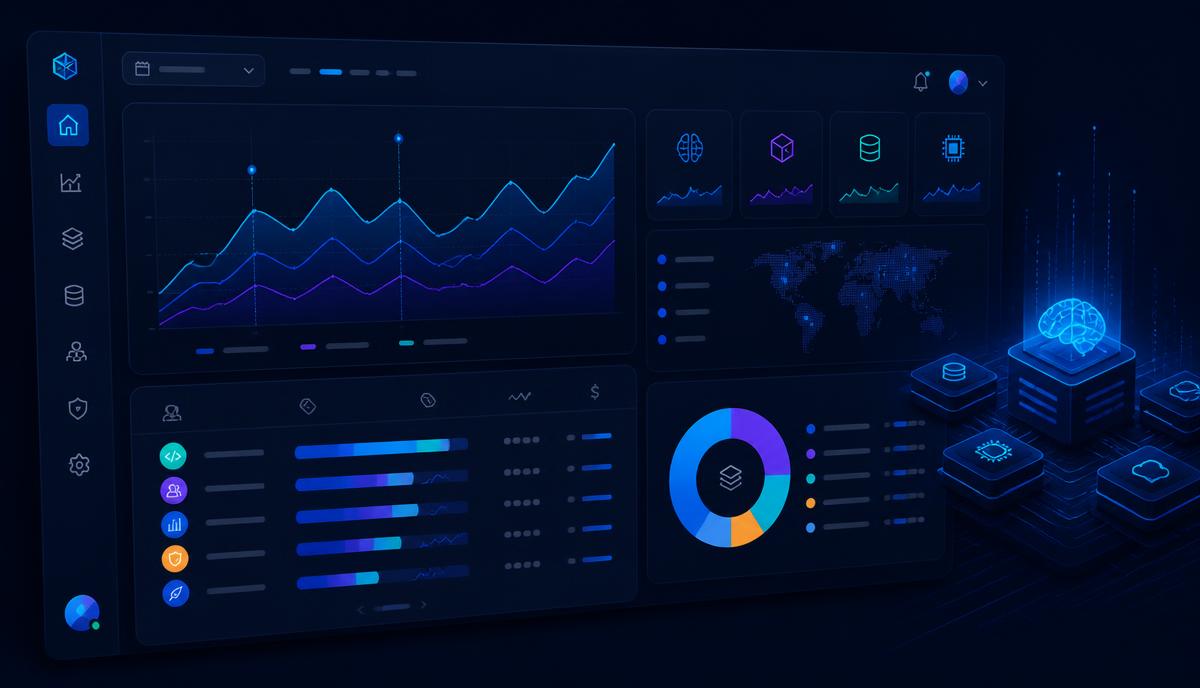
LLM cost optimization services: how SpendTensor services cut AI spend without slowing growth
A detailed guide to LLM cost optimization services for finance, platform, and AI teams: what SpendTensor services include, who needs them, which cost levers matter, and how to build a 90-day AI spend reduction program.

LLM cost optimization services are the operational work of finding, measuring, and removing wasted AI spend across model APIs, provider accounts, prompts, routing policies, cache layers, agent loops, evaluation jobs, and team budgets. The keyword is niche, but the problem is not: once a company has several AI features in production, the monthly invoice usually becomes too fragmented for finance to explain and too noisy for engineering to optimize. SpendTensor services exist for that moment. They combine AI spend management software with hands-on LLM FinOps support so teams can connect every provider, attribute every dollar, cut unnecessary token volume, and forecast the next invoice before it arrives.
The easy-to-miss truth is that AI bills rarely grow because one person decided to spend more. They grow because small model calls multiply. A support assistant adds retrieval context. A sales workflow adds enrichment. An internal agent starts retrying failed tool calls. A product team keeps a frontier model on a classification task because nobody has time to prove a cheaper model is safe. A finance team sees one consolidated provider invoice, but the cost was created by dozens of features, tenants, API keys, experiments, and background jobs. That is why LLM cost optimization services are different from ordinary SaaS procurement: the real savings come from technical usage patterns, not only from vendor negotiation.
What SpendTensor services include
The service starts with provider visibility across OpenAI, Anthropic, Google Gemini, Azure OpenAI, AWS Bedrock, xAI, Mistral, and self-hosted model gateways. SpendTensor normalizes usage into one view: model, provider, input tokens, output tokens, cached tokens, request outcome, latency, owner, feature, environment, tenant, and forecasted cost. From there the work moves into optimization: identifying oversized models, trimming prompts, separating cached and uncached input, moving non-interactive jobs to batch endpoints, adding semantic caching, setting team budgets, and routing alerts to the people who can actually act on them.
Who should look for LLM cost optimization services
The clearest fit is a company spending at least a few thousand dollars a month on AI APIs, using more than one model or provider, and planning to ship more AI features rather than fewer. Early-stage teams need visibility before the first invoice surprise. Growth-stage teams need cost allocation by product, tenant, and customer segment. Enterprise teams need governance: budgets, chargeback, procurement confidence, security review, and executive reporting. SpendTensor services are especially useful for support copilots, document automation, agentic workflows, internal knowledge bots, enrichment pipelines, AI search, coding assistants, and any product where one user action can trigger multiple model calls.
The first service layer is AI spend discovery
Discovery answers four questions: what are we spending, who owns it, why did it change, and which spend is not attached to a business outcome? A clean discovery phase imports 90 days of usage, reconciles provider totals against invoices, maps API keys to teams and features, separates production from development traffic, and finds shadow AI spend from untracked keys or expensed subscriptions. The deliverable is not a pretty chart; it is a defendable baseline that finance, engineering, and product can all agree on. Without that baseline, every cost-saving recommendation turns into a debate about whether the numbers are real.
The second service layer is model right-sizing
Many teams run too much traffic through frontier models because the first prototype worked and nobody revisited the choice. In production, classification, extraction, tagging, routing, short summarization, formatting, and policy checks are often safe on smaller models when a quality gate is in place. SpendTensor helps rank workloads by cost, compare cheaper models against real examples, and build fallback rules so quality stays protected. The goal is not to blindly downgrade models. The goal is to find the lowest-cost model that clears the quality bar for each task, then keep measuring after the change ships.
The third service layer is prompt and token efficiency
Output tokens frequently cost several times more than input tokens, yet most teams optimize prompts while allowing responses to ramble. Prompt efficiency starts by measuring median input and output tokens per feature, then looking for bloat: repeated boilerplate, dead few-shot examples, full conversation replay, over-wide retrieval, verbose JSON, and agent instructions copied into every step. SpendTensor services turn those findings into a practical token budget per workflow. That budget gives engineering a target that is specific enough to act on and stable enough for finance to forecast.
The fourth service layer is caching strategy
Provider prompt caching and application-level semantic caching solve different problems. Prompt caching reduces the price of repeated stable prefixes: system instructions, tool schemas, policy text, reference documents, and long context that stays the same across many calls. Semantic caching reduces repeated work when users ask meaningfully similar questions in different words. A good LLM cost optimization service checks both, because either one can save money or waste money depending on the access pattern. SpendTensor measures prefix stability, cache hit rate, cache freshness, tenant boundaries, and the real cost per served answer so caching decisions are based on math instead of hope.
The fifth service layer is routing and batch conversion
Routing sends each request to the best model-provider path for its job: quality-first when risk is high, cost-optimized when the task is routine, low-latency when the user is waiting, and cache-preferred when repeated context dominates the bill. Batch conversion is simpler but often overlooked: if nobody is waiting for the answer, the job should not pay interactive prices. Backfills, evaluation runs, enrichment, embeddings-adjacent classification, nightly reports, and bulk document processing often qualify. SpendTensor services help teams separate user-facing work from background work and move the background share to lower-cost execution paths.
The sixth service layer is budgets, guardrails, and alerts
Visibility without controls only explains the problem after the invoice arrives. SpendTensor services create operating rules: team budgets, project budgets, tenant ceilings, per-feature anomaly detection, retry caps, token ceilings, and alerts at forecast pace rather than only at static thresholds. The detail matters. An alert that says monthly AI spend is high is easy to ignore. An alert that says the support copilot is pacing 38% above budget because one enterprise tenant triggered a retry loop is actionable. Mature AI spend management turns every warning into an owner, a cause, and a next step.
The seventh service layer is reporting for finance and leadership
AI cost reporting must translate token behavior into business language. SpendTensor reports show cost per resolved conversation, cost per document processed, cost per active customer, spend by team, spend by feature, savings shipped, forecast accuracy, cache hit rate, model mix, and the top drivers of change. That reporting is what makes AI spend defensible. If a new feature doubles model usage but cuts manual review time by 70%, the spend may be healthy. If a background job grows 40% with no owner and no business metric, it is waste. Services help make that distinction visible.
A practical 90-day SpendTensor services plan starts with measurement, not cuts. Days 1–10 connect providers, import usage, reconcile invoices, and label the top workloads by team and feature. Days 11–20 publish the baseline, identify the top ten cost drivers, and pick three quick wins with low quality risk. Days 21–45 ship the first model right-sizing rules, output limits, prompt trimming, retry controls, and budget alerts. Days 46–70 add caching and batch conversion for workloads with clear math. Days 71–90 move into operating rhythm: weekly FinOps review, monthly leadership report, quarterly shadow-AI sweep, and a roadmap for routing, chargeback, procurement, and deeper automation.
What results should teams expect? The honest answer is a range
A company with no instrumentation and heavy frontier-model traffic can often find 30–60% reduction opportunities within a quarter. A company that already right-sized models may see a smaller but still meaningful gain from caching, retry control, tenant guardrails, and forecasting. The first month usually produces the fastest savings because obvious waste appears quickly once every request has an owner. The second and third months create durable savings: routing, batch, caching, semantic reuse, chargeback, and budget discipline. SpendTensor services are designed to make savings repeatable rather than a one-time cleanup.
How to evaluate an LLM cost optimization services provider
Ask whether they can normalize multiple providers, separate input, output, and cached tokens, attribute spend below the API-key level, reconcile to invoices, protect quality with evals, support budgets by owner, and explain savings in business terms. Ask whether they understand prompt caching break-even math, batch endpoint tradeoffs, agent retry loops, tenant limits, and model-routing risk. Most importantly, ask whether the service creates an operating system your team can keep using after the initial audit. A spreadsheet can find a few savings; an AI spend management platform changes the way spend is managed every week.
Common mistakes to avoid
Do not start by asking every team to use less AI; that creates fear and hides usage. Do not switch providers globally because one model looks cheaper on a pricing page; effective cost depends on cache behavior, output length, retries, and quality. Do not report cost without quality; a cheap answer that increases human review is not a saving. Do not use API keys as the only owner model; keys drift and shared keys hide accountability. Do not wait until renewal season to act; LLM cost optimization is continuous because model prices, usage patterns, and product surfaces change constantly.
Frequently asked questions
What are LLM cost optimization services? They are a combination of usage measurement, cost allocation, model right-sizing, prompt efficiency, caching, routing, batch conversion, budgets, alerts, and reporting for companies using large language models in production. How are SpendTensor services different from provider dashboards? Provider dashboards show what happened inside one provider account; SpendTensor shows cost across providers, teams, features, tenants, cache behavior, request outcomes, and forecasts. Can services cut AI spend without hurting product quality? Yes, when each change is paired with an evaluation or fallback rule. The savings come from wasted tokens, oversized models, repeated context, retries, and unowned workloads, not from making the product worse. How fast can savings appear? Measurement starts in days; first savings often appear in two to four weeks; durable operating changes usually take one quarter.
The bottom line
SpendTensor services are built for companies that need AI to keep growing but need the bill to become visible, explainable, and controllable. The niche keyword is LLM cost optimization services, but the category is broader: AI spend management, LLM FinOps, token budgeting, model routing, semantic caching, provider visibility, and finance-ready forecasting. If your team is running production AI across multiple features or providers, the next step is not to slow down. The next step is to put every token on a map, assign every dollar to an owner, and remove the work your AI bill should never have paid for in the first place.